
Wildfire Resilience Can't Stop at the Property Line

By Hillary Holcomb, Vice President, Operations
Two structures. The same simulated wildfire conditions. Two very different outcomes.
At a September fire demonstration in Colorado, State Farm® agent Jim Passarelli watched as two structures were exposed to the same conditions. One incorporated research-backed improvements designed to reduce wildfire risk, consistent with the Insurance Institute for Business & Home Safety (IBHS) Wildfire Prepared Home standard. The other lacked those protections.

“It was truly amazing to see the difference proper mitigation can make. After just 15 minutes under the same fire conditions, the contrast between the two structures was hard to miss,” Passarelli said.
The unprotected structure was fully engulfed in flames while the one with research-backed mitigation measures stood virtually untouched.
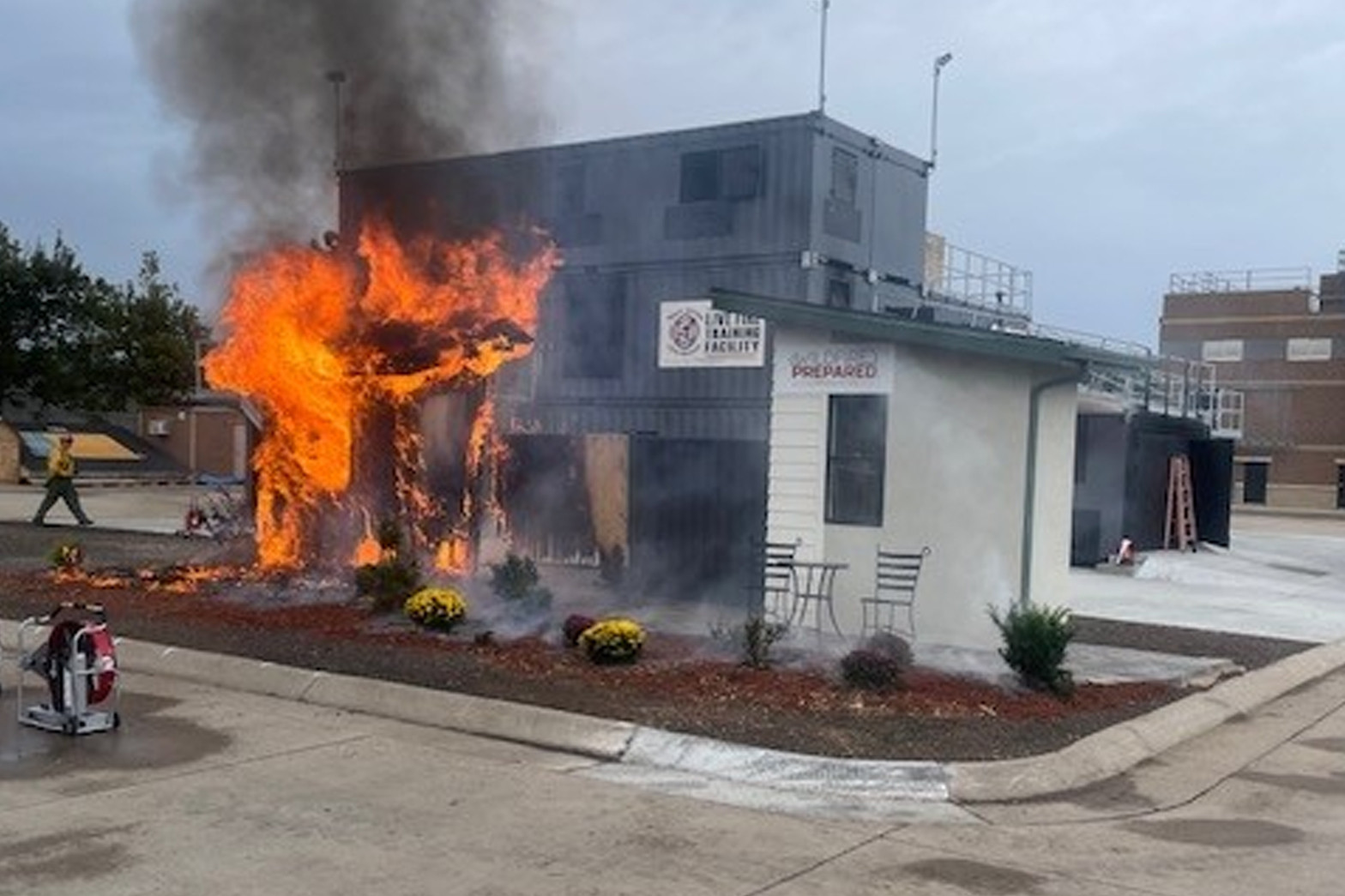
Now think about that in a real-world example, where there are more than two structures side by side. What if a whole block incorporated measures designed to reduce risk? What Jim witnessed illustrates something we need to make a bigger part of the wildfire conversation: Wildfires move through entire neighborhoods at once, not as a collection of individual properties. So should our approach to resilience.
Research is showing what works
State Farm has worked with IBHS for decades to better protect homes and communities, including helping launch its Research Center in 2010. We've also studied protective construction for more than 25 years through our Technology Research and Innovation Lab (TRAIL).
Following the 2025 Los Angeles County fires, IBHS researchers studied more than 250 properties there. Homes with four key protective features – a Class A roof, noncombustible siding, double-pane windows and enclosed eaves – had a 54% chance of avoiding fire damage, compared with 36% for homes with just one.
The research highlights the importance of multiple protective measures, including fire-resistant roofing, ember-resistant vents, and reducing combustible materials around a home. The area immediately surrounding a home is especially important. When flammable materials covered more than a quarter of the area within five feet of a home, the risk of fire damage or destruction approached 90%, according to IBHS research.
From homes to neighborhoods
IBHS is putting that research into practice through its Wildfire Prepared Neighborhood program, which builds on individual home protections by addressing risks across an entire community.
One example is Dixon Trail, a KB Home community in Escondido, California. The 64-home neighborhood is built to the IBHS Wildfire Prepared Home Enhanced standard.
The approach considers not just how individual homes are constructed, but also how their design, spacing and surrounding landscape can help limit the spread of fire.
Seeing the difference resilience makes
Fire demonstrations help people see how these protections work. Another demonstration was held Oct. 7 in Socorro, New Mexico, where the state also offers a certificate program recognizing homes that meet wildfire preparedness standards.
The next demonstration is scheduled for Oct. 26 in Panorama City, California, hosted by the California Fire Chiefs Association in partnership with IBHS.
Seeing the difference is one thing. Helping more homeowners and communities make these improvements is the next challenge.
Helping homeowners and communities take action
Insurers can support community-level action by recognizing steps homeowners and communities take to reduce wildfire risk. For example, eligible properties in communities recognized by Firewise USA may qualify for a community-level wildfire mitigation discount.
State Farm is helping lead the way in recognizing wildfire preparation, offering wildfire mitigation discounts in these 11 states, as of October: Arizona, California, Colorado, Idaho, Montana, New Mexico, Oklahoma, Oregon, Texas, Utah and Wyoming. Depending on the state and policy, discounts may recognize steps taken by individual homeowners or entire communities to help reduce wildfire risk.
Research is also looking into costs for wildfire resilience. A University of Colorado Boulder study found that building new homes to the IBHS Wildfire Prepared Home Essential standard increased construction costs by approximately 1.1% compared with conventional construction. The study did not estimate retrofit costs for existing homes, where improvements can be more complex and costly. The findings highlight opportunities to incorporate wildfire protections into new construction while reinforcing the importance of making improvements accessible to existing homeowners.
State Farm General Insurance Company also recently filed in California to consider new insurance applications for homes with qualifying IBHS Wildfire Prepared Home designations. This is pending review by the California Department of Insurance.
Public programs can also help make wildfire mitigation improvements more affordable and accessible. California has established initiatives to help qualifying homeowners strengthen their properties against wildfire, while some Colorado communities offer grants to support local wildfire risk-reduction projects.
Protecting communities takes all of us
I recently visited communities around Lake Tahoe, where I witnessed fire professionals, homeowners, community organizations and other partners working together to protect homes, neighborhoods and the surrounding landscape.
What struck me most was their shared commitment to solving a challenge no one individual or organization can tackle alone.
Insurers have an important role to play, too. Insights from decades of claims experience can help inform general guidance on reducing damage and encourage homeowners to take action.
Local State Farm agents can help customers understand available insurance discounts and point them to wildfire preparedness resources.
The work starts before the next fire
Helping people recover after disaster will always be fundamental to what we do. But we also have an opportunity to help homeowners find resources to help protect what matters before disaster strikes.
Over the past year, I’ve spoken with leaders in several fields about ways to make proven wildfire risk reduction measures more practical and accessible to homeowners.
The progress I saw around Lake Tahoe shows what's possible when people come together around a shared challenge. Now we need to build on that progress, helping more families protect their homes and more communities prepare for the future.
We intend to increase focus and investment in prevention and preparation, and you’ll hear more from us in the coming months.
About the author
Hillary Holcomb is a State Farm Vice President, Operations. Her leadership perspective connects the company's commitment to helping customers recover from unexpected losses with efforts to strengthen preparedness and resilience in the communities State Farm serves.
For over 100 years, the mission of State Farm has been to help people manage the risks of everyday life, recover from the unexpected and realize their dreams. State Farm Mutual Automobile Insurance Company and its affiliates are the largest providers of auto and home insurance combined in the United States. Its more than 19,200 agent offices and over 62,000 employees serve over 96 million policies and accounts – including auto, fire, life, health, commercial policies and financial services accounts. Commercial auto insurance, along with coverage for renters, business owners, boats and motorcycles, is also available. State Farm Mutual Automobile Insurance Company is the parent of the State Farm family of companies. State Farm is ranked No. 32 on the 2025 Fortune 500 list of largest companies. For more information, please visit http://www.statefarm.com.