
From Risk to Resilience: How Your Home Can Be More Fire-Resistant Than You Think
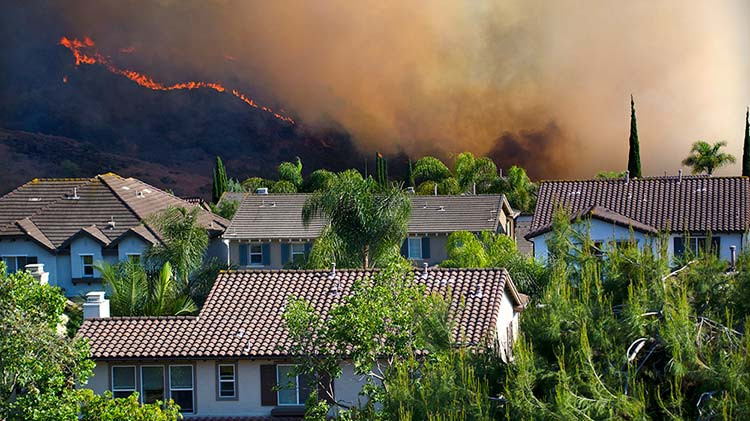
Wildfires are changing the way we think about home safety and insurance. With population growth in higher-risk areas, rising construction costs, and increasingly severe weather, what you do to protect your home and manage your coverage has never been more important.
Wildfire risk is increasing and becoming more than just a seasonal threat. Total annual forested acreage burned in the western U.S. is projected to rise by 107% by 2050 [1]. This increased risk means using the latest tools, technology and resources to better understand the unique dangers facing your community and home—not just the surrounding land but also factors like how your home is built and maintained.
We know that every neighborhood and every home is different. We also know price matters, as does providing quality service. We understand that maintaining reliable coverage in the communities where our customers live is both our most challenging and important promise. To offer support when it’s needed most, our agents—your neighbors—are here to guide you through your options and help you make decisions to meet your home insurance coverage needs.
Taking Action Before Disaster Strikes
Homeowners nationwide are confronting real and complex uncertainties about their coverage options and financial challenges in the marketplace. We understand that planning for wildfires can feel overwhelming and stressful, especially given the evolving nature of these risks and the difficulty of finding the right solutions. Many homeowners share concerns about how these impacts might affect their insurance and their ability to protect what matters most—their homes and families.
Mitigation can take thoughtful investment. Fortunately, recent research and innovative wildfire-resilient communities in Northern California are demonstrating how adequate defensible space and home hardening can be critical to reducing wildfire losses and ultimately shape safer neighborhoods. This science and information also help you, as a homeowner or renter, make informed decisions about how best to maintain your home or property to help avoid a loss. Combined with year-round maintenance, proper building material choice and following leading practices from industry experts, you can help create and manage a more fire-resistant home, no matter the season.
How To Get Started
If you haven’t taken steps to reduce wildfire risk, now is a good time to begin the process. Small actions like clearing nearby brushes can make a big impact in protecting your home and community. To prepare your home ahead of peak wildfire season, consider the Insurance Institute for Business & Home Safety (IBHS) Wildfire Prepared Home designation—a proven approach to reducing wildfire risk.
State Farm promotes home safety by partnering with leading organizations like IBHS to help build stronger and more resilient communities in the face of today’s emerging risks. Our goal is to provide products that help people manage the risks of everyday life whenever possible, while aligning price to risk, managing our exposure, and encouraging resilient actions.
Applying for Wildfire Prepared Home Certification Programs
Customers with properties that receive IBHS Wildfire Prepared Home or IBHS Wildfire Prepared Home Plus designation can receive a premium discount and some properties that are not currently eligible for coverage may become eligible with a Wildfire Prepared Home designation.
The IBHS Wildfire Prepared Home designation is available in several states. If you’ve completed a Critical Home Prep, you may qualify for the designation. Talk to your agent to learn more about the program’s availability in your state and whether your home qualifies for the related benefits.
More Ways to Build, Protect, and Save
- Protecting your home: Choose coverages, limits, and deductibles based on your home’s construction, roof condition, recent upgrades, and location.
- Planning for upgrades: If you’re thinking about home improvements, be cautious of contractor fraud and managing do-it-yourself projects alone. Always work with trusted professionals and keep records of any upgrades to support your insurance coverage.
- Recording a home inventory: Document what you own: A quick video walkthrough on your phone can make a real difference if you ever need to file a claim.
- Ask about wildfire discounts: Depending on where you live and how your home is certified, you may qualify for savings. Your State Farm agent can provide information and resources quickly.
Learn more about the additional steps you can take to eliminate ignition factors and follow a wildfire resilience checklist.
In addition to Wildfire Prepared Home, State Farm is supportive of the development of community-based wildfire prevention and preparedness standards. We are among the more than 100 innovative and diverse FLASH partners that share its vision of making America a more disaster-resistant nation. We also work directly with legislators and regulators across the country on real solutions to promote homeowner resiliency and the availability of insurance to protect what matters most before, during, or after a loss.
[1] Abatzoglou, J. T., Battisti, D. S., Williams, A. P., Hansen, W. D., Harvey, B. J., & Kolden, C. A. (2021). Projected increases in western US forest fire despite growing fuel constraints. Communications Earth & Environment, 2(1), 227. https://doi.org/10.1038/s43247-021-00299-0
About State Farm:
For over 100 years, the mission of State Farm has been to help people manage the risks of everyday life, recover from the unexpected and realize their dreams. State Farm Mutual Automobile Insurance Company and its affiliates are the largest providers of auto and home insurance combined in the United States. Its more than 19,200 agent offices and over 62,000 employees serve over 96 million policies and accounts – including auto, fire, life, health, commercial policies and financial services accounts. Commercial auto insurance, along with coverage for renters, business owners, boats and motorcycles, is also available. State Farm Mutual Automobile Insurance Company is the parent of the State Farm family of companies. State Farm is ranked No. 32 on the 2025 Fortune 500 list of largest companies. For more information, please visit http://www.statefarm.com.
Media Contact

|
Media Inquiries |